
A 0.5% engagement rate on Instagram. Is that good or bad?
The honest answer: it depends. In fact, it depends on your industry, your follower count, your content format, and which platform you’re measuring. Most social media managers, however, benchmark their performance against a single number — ‘the average’ — and draw the wrong conclusions.
This guide cuts through the confusion. Below are the 2026 social media benchmarks across TikTok, Instagram, LinkedIn, X, and Facebook — broken down by platform, industry, and what actually drives performance this year. More importantly, we’ll show you how to use these benchmarks to measure your competitors, not just yourself.
Data source: All benchmarks in this guide are sourced from Socialinsider’s 2026 report (70M+ posts analyzed), supplemented by Rival IQ, Buffer (52M posts), and SociaVault Labs (350K+ accounts). Where sources conflict, we use the most conservative estimate.
The 2026 Benchmarks at a Glance
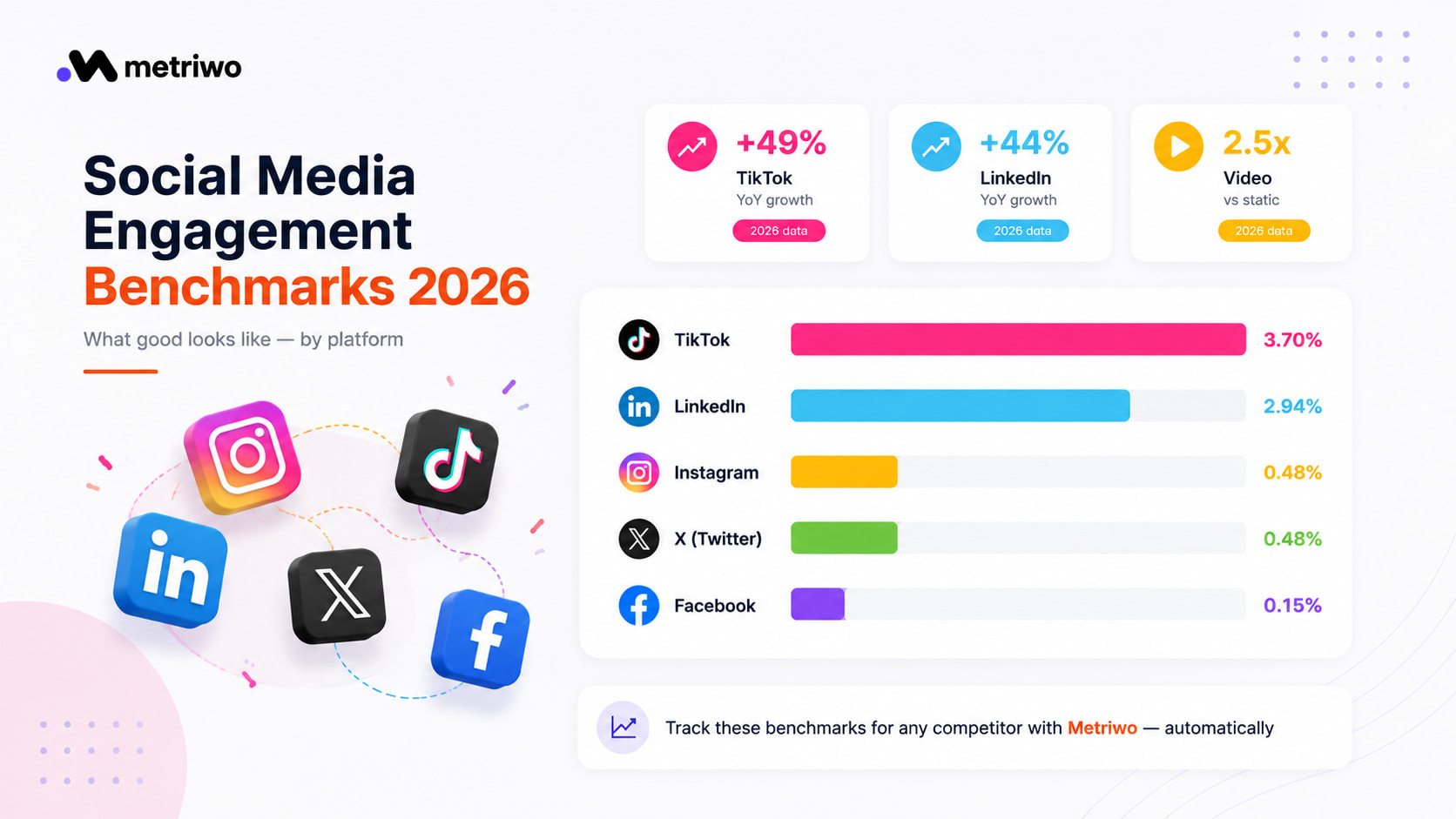
First, the headline numbers. These are average engagement rates across all industries and account sizes for each platform in 2026:
| Platform | Avg Engagement Rate | YoY Change | Best Content Format | Best For |
| TikTok | 3.70% | +49% YoY | Short video (15-30 sec) | B2C, Entertainment, Education |
| 2.94% | +44% YoY | Document posts, Polls | B2B SaaS, Technology | |
| 0.48% | Flat | Reels (+44% vs static) | Visual brands, E-commerce | |
| X (Twitter) | 0.48% | Stable | Real-time text posts | News, Tech, Thought leaders |
| 0.15% | Declining | Video, Local content | Local business, 35-54 age |
Consequently, the single biggest story of 2026 is that TikTok is pulling further ahead. Its 3.70% average engagement rate is 7.7x higher than Instagram and 24.7x higher than Facebook. Meanwhile, LinkedIn quietly became the fastest-growing platform for engagement, up 44% year-over-year — a trend most brands haven’t caught up with yet.
Key insight: Video wins across every platform in 2026. Short-form video generates 2.5x more engagement than static content. Instagram Reels deliver 44% higher engagement than feed posts. If you’re not posting video, you’re working against the algorithm on every platform.
Why ‘Average’ Benchmarks Are Misleading
Before you compare your numbers to the table above, however, there are two variables that matter more than the platform average:
1. Your follower count changes everything
Engagement rate has an inverse relationship with audience size on every platform. The larger your following, the lower your expected engagement rate. For example, a 2% Instagram engagement rate is mediocre for a 5,000-follower account — and exceptional for a 500,000-follower account.
Always benchmark against accounts in the same follower tier, not against the platform-wide average.
2. Your industry sets the baseline
A 0.84% Instagram engagement rate sounds weak — until you realize that’s the benchmark for B2B SaaS. For that industry, 0.84% is exactly average. Compare yourself to your vertical, not the overall number.
| Industry | TikTok ER | Instagram ER | LinkedIn ER | Best Platform |
| B2B SaaS | 3.0% | 0.84% | 2.80% | |
| E-commerce | 4.5% | 1.45% | 1.67% | TikTok |
| Education | 7.36% | 2.10% | 1.85% | TikTok |
| Media/Entertainment | 5.2% | 1.29% | 1.57% | TikTok |
| Healthcare | 3.4% | 1.21% | 1.81% | LinkedIn (B2B) |
| Financial Services | 1.9% | 0.67% | 1.75% | |
| Food & Beverage | 4.9% | 1.40% | 1.48% | TikTok |
| Technology/Software | 3.7% | 0.84% | 1.95% | LinkedIn / X |
The education vertical is an outlier worth noting. At 7.36% on TikTok, educational content gets nearly 2x the platform average. The TikTok algorithm specifically favors informational content — if your brand has anything educational to share, TikTok should be a priority.
Platform-by-Platform Breakdown
TikTok — 3.70% average engagement rate
TikTok remains the highest-engagement platform by a significant margin. Its ‘For You’ algorithm distributes content based on interest signals rather than follower count, which means new accounts get a genuine shot at reach that’s simply not available on other platforms.
What works in 2026: Duets and Stitches generate the highest engagement (5.1%), followed by trending sounds (4.6%) and text-on-screen explainers (4.2%). Videos under 30 seconds consistently outperform longer content.
Who should prioritize TikTok: B2C brands, education, entertainment, food and beverage, and e-commerce. B2B brands see lower TikTok ER (3.0% for SaaS) but can still use it effectively for brand awareness and founder-led content.
Benchmark to beat: If your TikTok ER is above 3.70%, you’re above average. Above 5%, you’re in the top quartile.
LinkedIn — 2.94% average engagement rate
LinkedIn is the benchmark story of 2026. Up 44% year-over-year, it’s now the fastest-growing engagement platform — and most B2B brands haven’t fully capitalized on it yet.
What works in 2026: Document posts (PDFs) generate the highest engagement at 3.2% — 73% above baseline. Polls follow at 2.8%. Text-only founder posts consistently outperform image posts, as LinkedIn’s algorithm rewards authentic personal voice.
Who should prioritize LinkedIn: B2B SaaS (2.8% ER), technology, manufacturing, professional services. If you’re selling to business decision-makers, LinkedIn should be your primary organic channel.
Benchmark to beat: For B2B SaaS, 2.8% is your average. Above 4.5% puts you in the top quartile for your vertical.
Instagram — 0.48% average engagement rate
Meanwhile, Instagram’s engagement rate has stayed nearly flat in 2026, continuing a multi-year decline from its peak. The platform’s algorithm heavily favors Reels, which deliver 44% higher engagement than static feed posts.
What works in 2026: Reels first, carousels second. Static posts should be used sparingly — they reach 18-28% of followers for smaller accounts, down from 40-50% in 2024.
Who should prioritize Instagram: E-commerce (1.45% ER), food and beverage (1.40%), education (2.10%), and any brand with strong visual content.
Benchmark to beat: 0.48% is the platform average. For most B2C brands, 1%+ is a realistic target. For B2B, 0.5-0.8% is solid performance.
X (Twitter) — 0.48% average engagement rate
In contrast, X has stabilized at 0.48% after several years of decline. Real-time content and text-first posts remain the strongest formats. The news and media sector sees the highest engagement at 0.67%, while retail averages 0.39%.
Who should prioritize X: Tech brands, developer tools, media, and any brand that benefits from real-time commentary and thought leadership. Less suited for visual B2C brands.
Facebook — 0.15% average engagement rate
Facebook’s organic engagement continues to decline. For most B2B brands (SaaS, technology), Facebook is now effectively a paid-only channel — organic posts generate 0.28-0.32% engagement, making it the lowest-ROI platform for organic content.
Who still gets value from Facebook: Local businesses, real estate (4.64% ER — the highest on Facebook), nonprofits, and brands targeting the 35-54 age demographic. Facebook Groups also drive higher engagement than business pages.
How to Use Benchmarks to Analyze Your Competitors
Nevertheless, knowing the platform benchmarks is only half the picture. The more valuable comparison is against your direct competitors — because industry averages hide the gap between you and the brands actually competing for your audience.
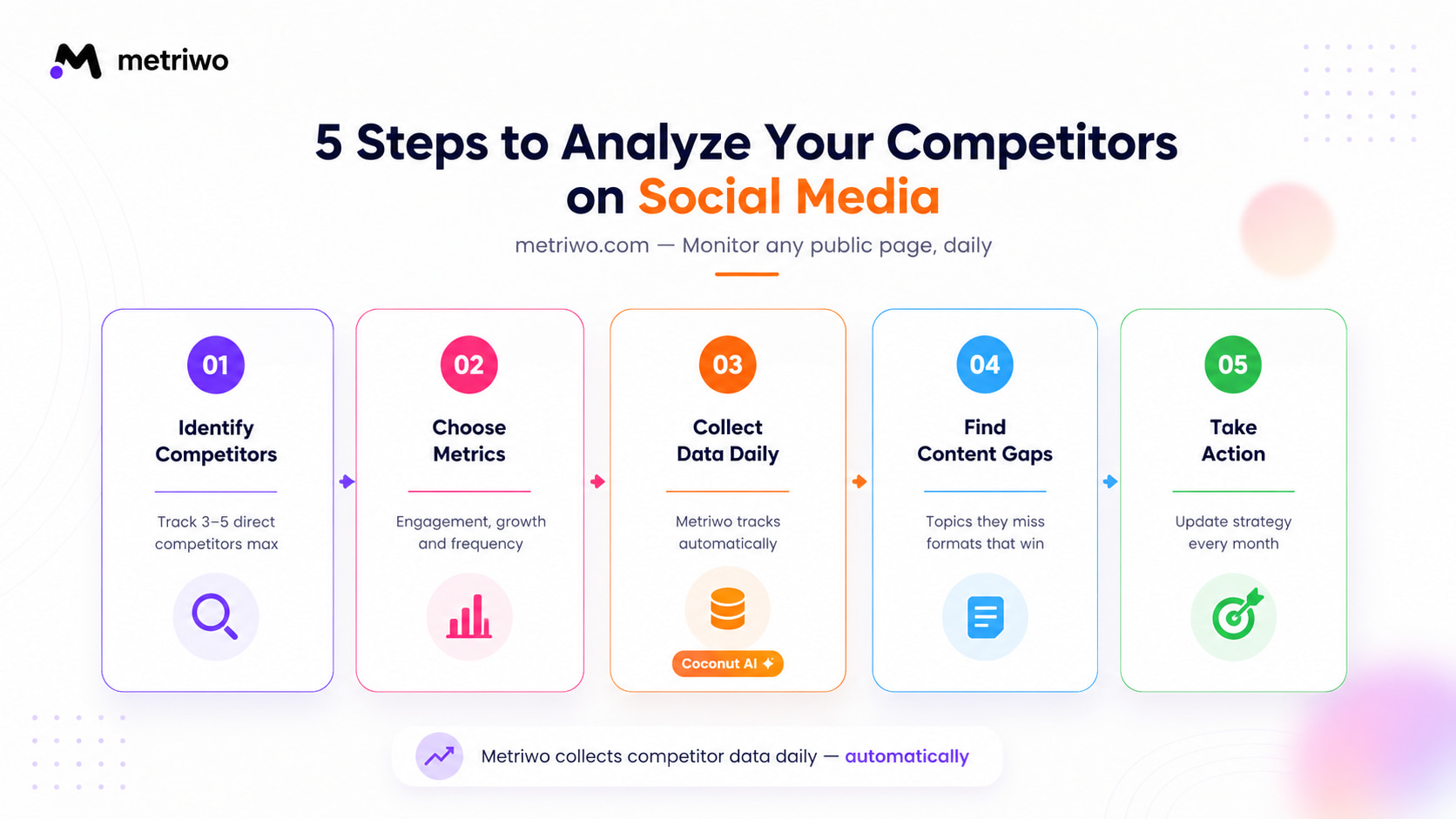
Here’s how to build a competitor benchmark analysis:
- Pick 3-5 direct competitors. Not aspirational brands — actual competitors targeting the same audience.
- Track the same metrics across all of them. Engagement rate, follower growth rate, posting frequency, and top-performing content format. Compare apples to apples.
- Look for outliers. If one competitor is consistently 2x above the others on TikTok, study their content. What format? What topics? What posting frequency?
- Check their follower quality. A competitor with strong engagement metrics but 30% fake followers has a smaller real audience than it looks. Fake follower analysis changes how you interpret competitor benchmarks.
- Monitor changes over time. A single snapshot isn’t enough. What matters is whether a competitor’s engagement is growing or declining — and how fast.
Metriwo note: Metriwo monitors any public Instagram, Facebook, X, LinkedIn, or TikTok account daily — without needing access to that account. Coconut, Metriwo’s AI assistant, surfaces the most significant changes automatically so you know when a competitor is outperforming the benchmark before it becomes a trend.
What a ‘Good’ Engagement Rate Actually Means in 2026
The most common mistake: comparing your engagement rate to the platform average without accounting for your follower tier and industry.
Here’s a practical framework:
- You’re underperforming if you’re more than 30% below your industry benchmark consistently for 3+ months. Look at content format, posting frequency, and audience quality.
- You’re performing average if you’re within 20% of your industry benchmark. Focus on incremental improvements — better hooks, more consistent posting, more Reels.
- You’re outperforming if you’re 30%+ above your industry benchmark. Document what’s working and double down before competitors catch up.
- You’re in the top quartile if you’re consistently 50%+ above your industry benchmark. At this point, benchmark against your direct competitors, not the industry average.
One final note: benchmarks are averages, not targets. The goal isn’t to hit 3.70% on TikTok — it’s to outperform your specific competitors for your specific audience. Use industry benchmarks to calibrate expectations, and competitor benchmarks to drive strategy.
See how your competitors measure up against these benchmarks. Metriwo tracks engagement rate, follower growth, and posting frequency for any public social media account — daily. No access needed. Coconut AI highlights when a competitor is pulling ahead. metriwo.com →
The Bottom Line
The 2026 benchmark numbers tell a clear story: TikTok and LinkedIn are growing, Instagram is holding steady, and Facebook is in structural decline for organic content. Video wins everywhere.
However, platform averages are a starting point, not a destination. The brands that consistently outperform aren’t chasing the industry average — they’re tracking their specific competitors, identifying what’s working in their niche, and adapting before the trends become obvious.
Therefore, use the benchmarks in this guide to calibrate your expectations. Then build a competitor monitoring practice that turns benchmark data into actual strategy.