
A competitor just hit 200,000 followers on Instagram. Should you be worried?
Maybe. However, before you rethink your entire content strategy based on someone else’s follower count, it’s worth asking a more useful question: how many of those 200,000 followers are real?
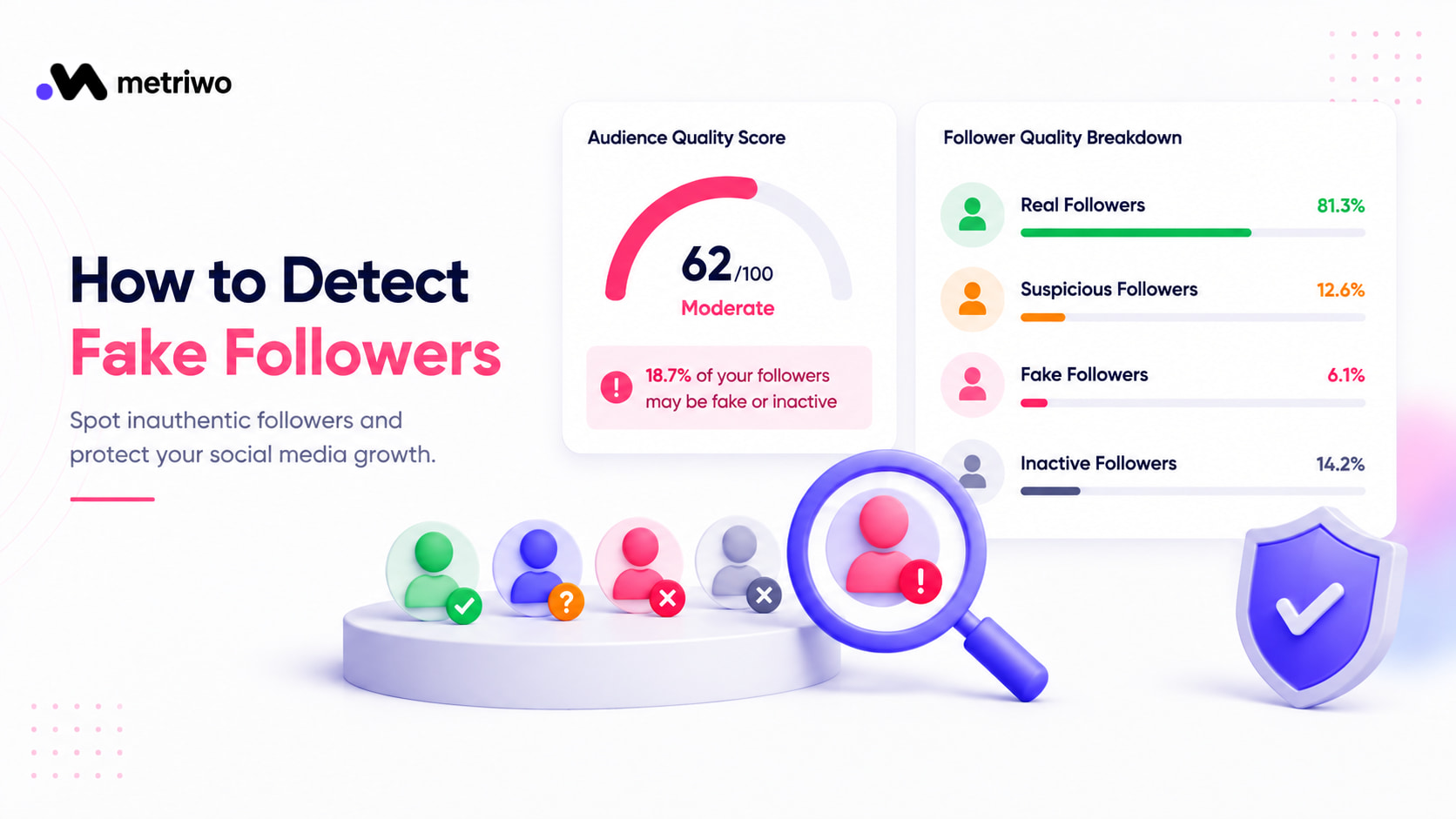
In fact, fake followers are more common than most social media managers realize. They inflate vanity metrics, distort competitive benchmarks, and can actively hurt your reach if they’re on your own account. This guide covers how to detect fake followers on any account, what signals to look for, and how this data should change the way you analyze competitors and evaluate influencer partnerships.
Industry data: Research estimates that the average influencer account carries around 37% fake or inactive followers. On Instagram, roughly 10% of all accounts are estimated to be bots or spam. Fake followers above 25% on any account is generally considered a red flag.
What Are Fake Followers, Exactly?
Not all fake followers are the same. Therefore, it helps to understand the different types:
Bot accounts are automated accounts created at scale. They follow, like, and sometimes comment using scripted behavior. They have no real person behind them.
Purchased followers are bought in bulk through third-party services. They may be bots, inactive accounts, or real people from completely irrelevant geographies paid to follow an account.
Inactive followers are real people who created accounts but stopped using the platform. They were never fake. They just stopped engaging. Every account accumulates these over time.
Engagement pod followers are real accounts that participate in coordinated groups where members agree to like and comment on each other’s content. This inflates engagement metrics without representing genuine audience interest.
Consequently, the distinction matters because inactive followers are a natural part of any account, while purchased followers and bots are a deliberate strategy to inflate numbers. In a competitor analysis, you’re primarily looking for the latter.
Why Fake Followers Matter for Your Strategy
The obvious answer is that fake followers distort engagement rates. However, the strategic implications go further.
It changes how you interpret competitor growth
For example, if a competitor gained 50,000 followers last quarter, the natural reaction is to worry about what they’re doing differently. But if 30,000 of those followers were purchased, the real story is that their organic growth was modest, maybe even weaker than yours.
Benchmarking your performance against inflated numbers leads to bad decisions: unnecessary strategy pivots, budget shifts, or confidence problems that aren’t grounded in reality.
It affects influencer partnership decisions
An influencer with 100,000 followers and 30% fake followers has roughly 70,000 real followers. If you’re paying based on their total follower count, you’re overpaying by 30%. At scale, across multiple influencer campaigns, this becomes a significant budget problem.
Fake followers on your own account hurt your reach
Furthermore, this is the part most people miss. Instagram, TikTok, and other platforms use engagement rate to determine how widely to distribute your content. If a large percentage of your followers are inactive or fake, your engagement rate drops, and the algorithm shows your content to fewer real people.
A smaller, genuinely engaged audience consistently outperforms a large, inflated one in terms of actual reach and conversion.
Key insight: Fake followers don’t just make numbers look bad. they actively suppress your content distribution on algorithmic platforms like Instagram and TikTok.
Signals That Indicate Fake Followers
You don’t always need a tool to spot a heavily inflated account. These signals are visible on any public profile:
| Signal | What it looks like | Reliability |
| Engagement rate vs follower count | 500K followers but only 300 likes per post | High |
| Follower growth spike | Gained 40K followers in 3 days, then flatlined | High |
| Follower profile quality | No profile photo, zero posts, following 5,000+ accounts | High |
| Comment quality | eneric praise: ‘Great post!’ ‘Love this!’ in every comment | Medium |
| Following-to-follower ratio | Follows 8,000, has 9,000 followers: suspicious symmetry | Medium |
| Geographic mismatch | Brand targeting US, but 70% of followers from Southeast Asia | High |
| Engagement pods | Same 30 accounts comment on every single post within minutes | Medium |
Nevertheless, no single signal is definitive on its own. An account can have a genuine follower spike from going viral. Generic comments might just reflect a passive audience. Look for multiple signals appearing together. That’s when it becomes meaningful.
How to Check for Fake Followers
There are two approaches: manual inspection and automated tools. Both have a role. Manual inspection For a quick sense check on any account:
Check engagement rate. Divide average likes + comments per post by total followers. Multiply by 100. For most accounts, 1–5% is normal on Instagram. Significantly below 1% on a large account is a red flag.
Look at the follower growth chart. Most analytics tools (including Metriwo) show follower growth over time. A sudden spike followed by a plateau usually indicates purchased followers.
Browse followers manually. Click through 20–30 followers at random. Look for: no profile photo, no posts, following thousands of accounts, generic usernames with random numbers. If more than a quarter look like this, the account has a real fake follower problem.
Read the comments. Genuine engagement includes specific references to the post content. Fake engagement is vague: ‘Nice!’, ‘Love this’, single emojis, or completely off-topic remarks.
Manual inspection works for a spot check. However, it doesn’t scale if you’re monitoring multiple competitors or evaluating dozens of influencers.
Using a fake follower detection tool
A dedicated tool automates the analysis and gives you a percentage score rather than a gut feeling. What to look for in a tool:
- Analyzes the full follower base, not just a sample
- Provides a clear fake follower percentage, not just flags
- Works on any public account, not just your own
- Shows follower growth trends over time so you can spot purchase events
- Covers multiple platforms, not just Instagram
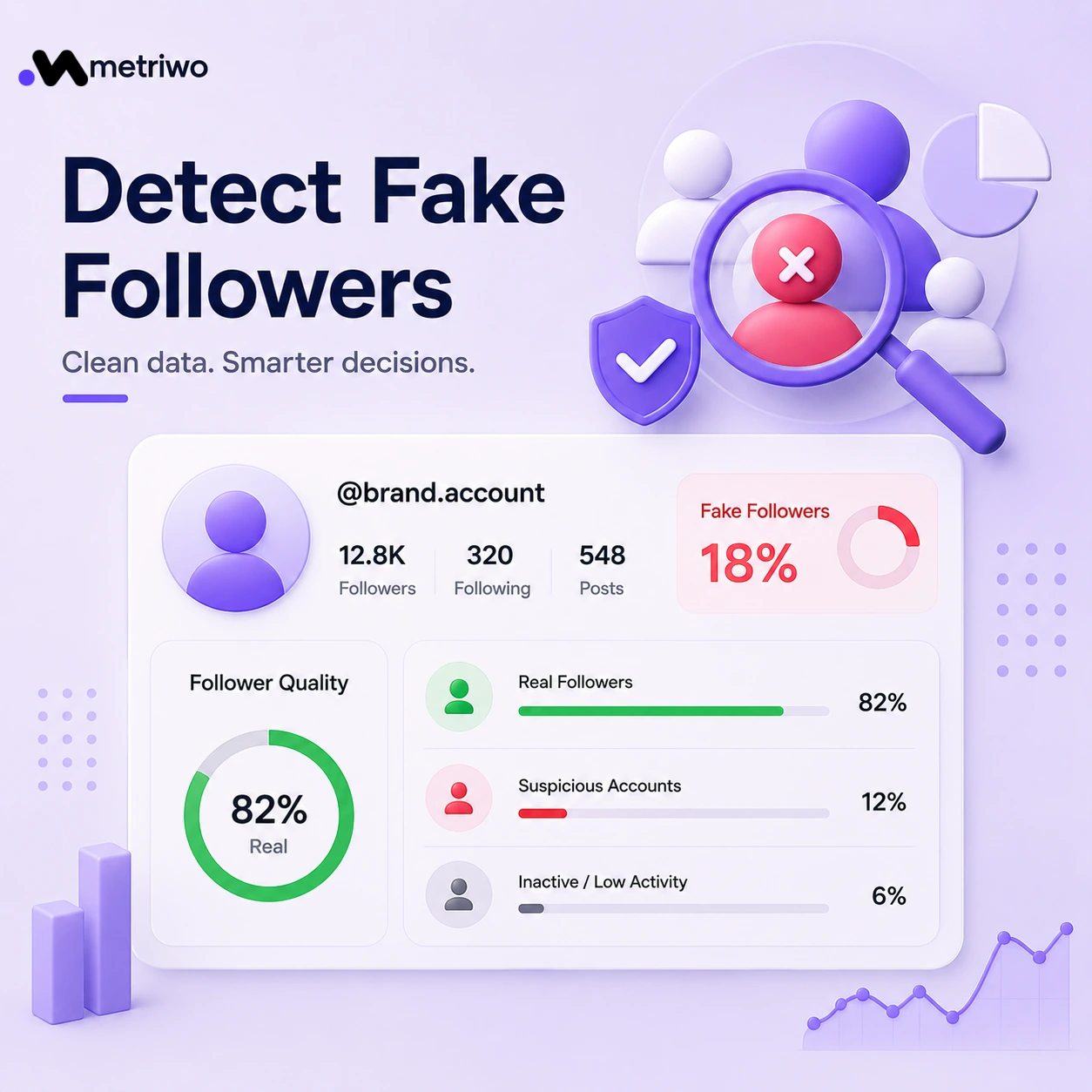
Metriwo’s fake follower detection checks any public Instagram, Facebook, X, LinkedIn, or TikTok account, no login required for competitor pages. The result is a clear percentage score alongside follower growth history and engagement data, so you can see the full picture in one place.
How to Use Fake Follower Data in Practice
Knowing that an account has fake followers is only useful if you act on it. Here’s how this data applies to the most common scenarios:
| Use case | What fake follower data tells you | Action to take |
| Competitor has 200K followers but weak engagement | Follower base may be partially inflated, their real reach is smaller than it looks | Don’t benchmark your own growth against their vanity numbers |
| Potential influencer partner has 80K followers | Whether those followers are real, active, and in the right geography | Negotiate price based on real audience, not total follower count |
| Your own account’s engagement dropped | Whether a follow-for-follow campaign or aggressive following attracted low-quality followers | Audit and remove fake followers to restore engagement rate |
| New competitor appeared and grew fast | Whether their growth is organic or purchased | If inflated, don’t panic. their audience isn’t real traction |
What to Do If Your Own Account Has Fake Followers
First of all, don’t panic. Every account accumulates some fake and inactive followers over time. The question is whether the percentage is high enough to be hurting your reach.
If your fake follower rate is above 15–20%, it’s worth taking action:
Audit your follower acquisition history. Did you run a follow-for-follow campaign? A giveaway that attracted low-quality accounts? Paid promotion in the wrong geography? Identifying the source helps you avoid it in future.
Remove fake followers on Instagram. Instagram allows you to remove followers from your account without blocking them. Go to your followers list, tap the three dots next to a suspicious account, and select Remove Follower.
Stop tactics that attract fake followers. Follow-for-follow, buying followers, and some giveaway formats consistently attract low-quality accounts. The short-term follower boost isn’t worth the long-term engagement penalty.
Monitor monthly going forward. A tool like Metriwo tracks your fake follower percentage over time, so you can catch problems before they compound.
Worth knowing: Removing fake followers typically improves your engagement rate immediately — because the same real engagement is now divided by a smaller, more accurate follower count. A smaller number that’s real is better than a large number that’s padded.
The Bottom Line
Follower counts are the most visible metric on social media — and the most easily manipulated. A competitor with 300,000 followers and 25% fake followers has a real audience of around 225,000. A competitor with 80,000 followers and 5% fake followers has a more genuine audience of 76,000.
The second account probably has better engagement, better reach, and more actual influence. But without fake follower detection, you’d likely be more impressed by the first.
Real competitive intelligence means looking past the numbers on the surface. Fake follower analysis is one of the fastest ways to separate genuine growth from inflated vanity metrics, and it changes the way you benchmark your competitors, evaluate partnerships, and grow your own presence.
Check any account, yours or a competitor’s. Metriwo’s fake follower detection runs on any public Instagram, Facebook, X, LinkedIn, or TikTok account. No login required for competitor pages. See the real numbers behind any follower count. metriwo.com