
In fact, you don’t need to guess what’s working in your industry. Your competitors are already publishing that data publicly. Follower counts, engagement rates, top posts, posting frequency, and content strategy are all visible to anyone who knows where to look.
This guide walks you through exactly how to do a social media competitor analysis: what to look for, which metrics actually matter, how often to do it, and how to turn the data into decisions.
What Is a Social Media Competitor Analysis?
A social media competitor analysis is the process of systematically reviewing your competitors’ social media presence to understand their strategy, benchmark your own performance, and find opportunities they’re missing.
When done right, it answers questions like:
• Why is that account growing faster than ours?
• What content formats are driving the most engagement in our industry?
• Which platforms are our competitors ignoring and should we be there instead?
• Are their 200,000 followers real, or inflated with fake accounts?
Most teams do this manually, once a quarter, using spreadsheets. That’s better than nothing. However, it only gives you a snapshot. but the brands that win on social are the ones monitoring competitor data continuously, not just taking a quarterly snapshot.
Key insight: Competitor strategies shift fast. A post format that got 2% engagement in January might be hitting 8% by March. Daily monitoring catches these shifts early. Quarterly analysis misses them entirely.
Step 1 : Identify the Right Competitors to Track
Most teams make the mistake of tracking too many competitors, or tracking the wrong ones. Here’s how to build a useful competitor list:
Direct competitors sell the same product or service to the same audience. These are your primary benchmark. Aim for 3–5.
Indirect competitors solve the same problem differently. Worth watching for content angles and audience overlap.
Aspirational accounts aren’t competitors but have mastered the content or audience you want. Good for creative benchmarking.
Practical tip: Don’t track more than 7–8 competitors total. More than that and the data becomes noise. Pick the ones your audience is most likely to follow alongside you.
Step 2 : Decide Which Metrics to Track
Not all metrics are equally useful. Here’s what actually matters in a competitor analysis, and what each metric tells you:
| Metric | What it tells you | How often to check |
| Follower growth rate | Is their audience growing, shrinking, or stagnant? | Weekly |
| Engagement rate | Does their audience actually care about their content? | Weekly |
| Posting frequency | How active are they: daily, 3x/week, sporadic? | Weekly |
| Top-performing content | What formats and topics get the most response? | Monthly |
| Platform focus | Where are they investing their effort? | Monthly |
| Follower overlap | How much of your audience also follows them? | Monthly |
| Fake follower % | Is their large following real or inflated? | Once/quarter |
Two metrics in this list deserve extra attention:
Engagement rate is more important than follower count. A competitor with 50,000 followers and 0.5% engagement is less of a threat than one with 10,000 followers and 4% engagement. The second audience is actually paying attention.
Fake follower percentage is underused. If a competitor’s follower count looks impressive but 30–40% are fake or inactive accounts, their reach is much smaller than it appears. This is a real competitive insight and one that’s hard to spot without a dedicated tool.
Step 3 : Gather the Data
There are two ways to collect competitor data: manually, or with a monitoring tool.
Manual approach
Visit each competitor’s profile directly. Screenshot their bio, follower count, and recent posts. Record engagement on their last 10–20 posts. Track posting frequency by counting posts per week.
Honest assessment: this works for a one-off analysis. It doesn’t scale, it’s slow, and it only gives you a snapshot not a trend line. If a competitor grew 8% last month but you only check quarterly, you miss that entirely.
With a competitor monitoring tool
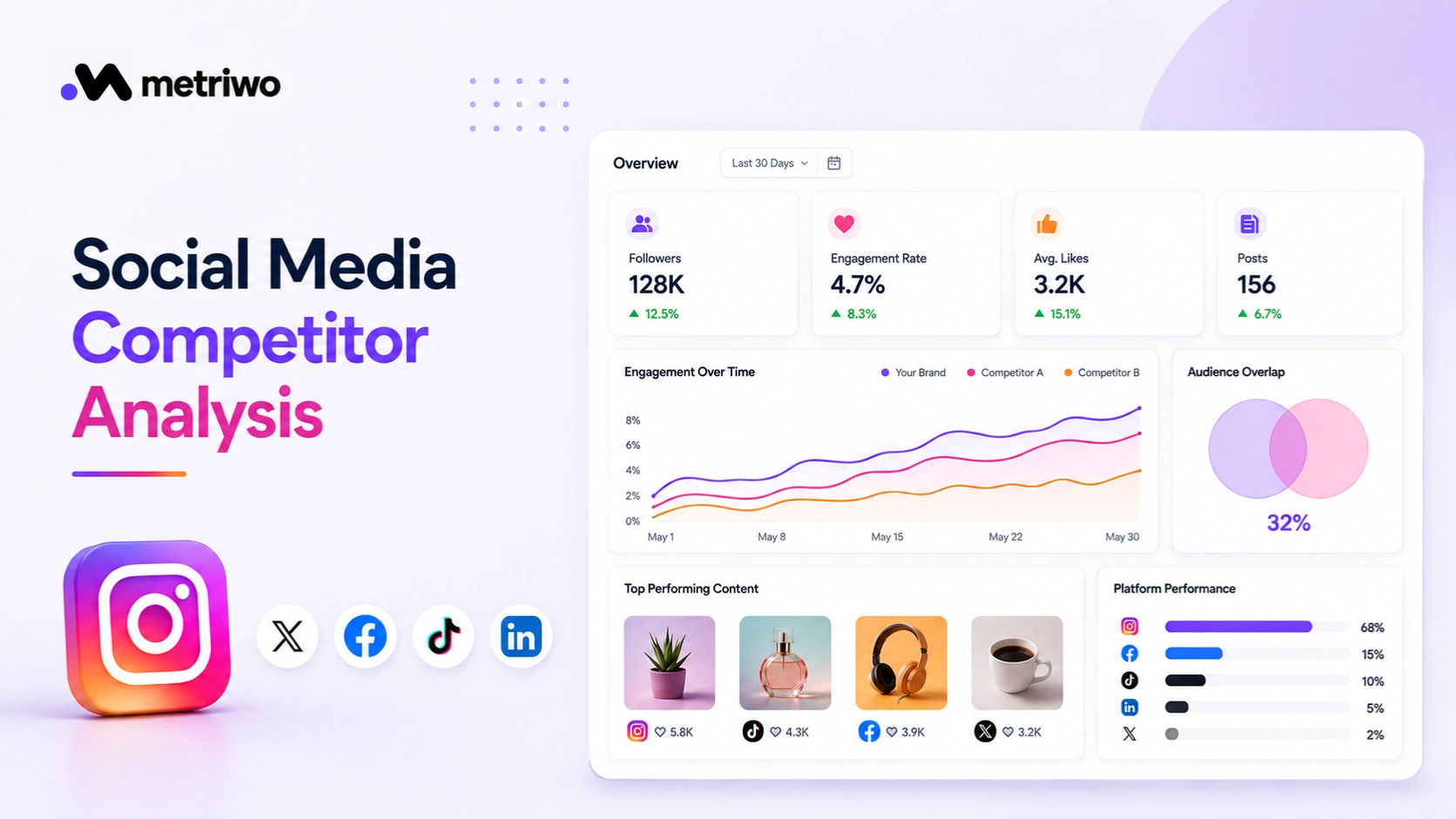
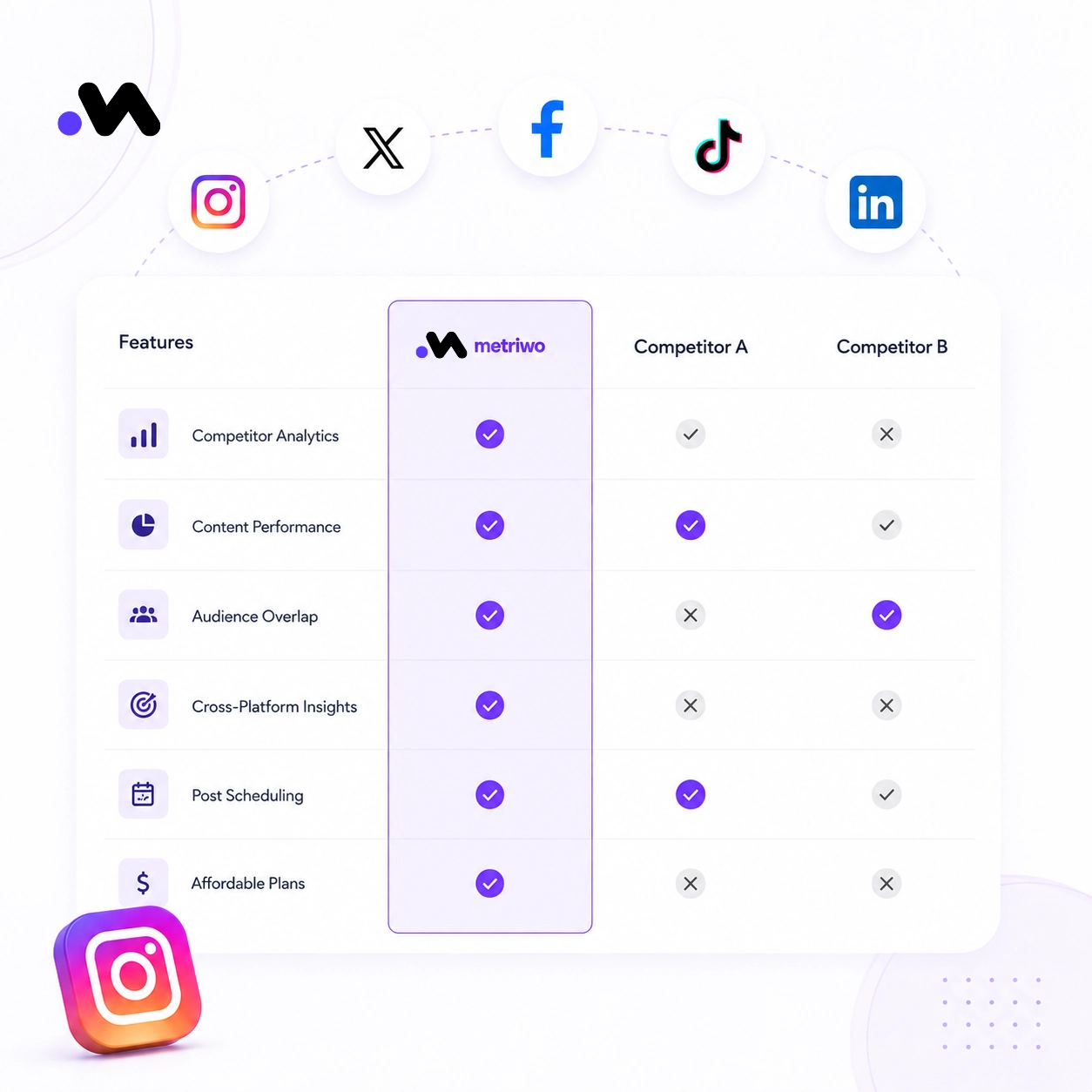
As a result, a tool like Metriwo connects directly to public social pages and collects data daily, automatically. You get follower growth trends over time, engagement rate history, top-performing content by format, posting frequency patterns, and follower overlap between your audience and theirs.
The difference isn’t just convenience. Daily data reveals patterns that quarterly snapshots hide, like a competitor testing a new content format, doubling down on Reels, or suddenly going quiet.
Metriwo note: Metriwo monitors any public Instagram, Facebook, X, LinkedIn, or TikTok page without needing access to that account. Data is collected daily. Coconut, Metriwo’s AI assistant, highlights the most significant changes automatically.
Step 4 : Analyze What You Find
Raw numbers aren’t useful on their own. Therefore, the goal is to identify patterns and turn them into decisions. Here’s how to structure your analysis:
Content performance patterns
Look at which post formats (Reels, carousels, static images, Stories, text posts) generate the highest engagement for each competitor. If three of your five competitors are getting 3x more engagement on short-form video than on static images, that’s a signal about what your shared audience responds to.
Posting frequency and timing
Additionally, note how often competitors post and when. A competitor posting daily at 7am and consistently getting strong early engagement has likely tested this timing. You don’t need to copy it, but you should test whether it works for your audience too.
Content themes and gaps
What topics are competitors covering heavily? Furthermore, what are they ignoring? If five competitors all post about scheduling tips but none are covering competitor strategy or analytics, that’s a content gap you can own.
Audience quality check
A competitor with rapid follower growth is only worth worrying about if that growth is real. Use fake follower detection to check whether their numbers reflect genuine audience interest or inflated vanity metrics.
Step 5 : Turn Insights Into Action
A competitor analysis that doesn’t change your strategy is wasted effort. Here’s how to close the loop:
- Benchmark your own metrics. Once you have competitor data, consequently, compare it to your own. Where are you ahead? Where are you behind? Be honest.
- Identify one content format to test. If competitors are consistently outperforming you on a specific format, run a 30-day test with that format on your own channels.
- Find two topics to own. Look for subjects that are underserved in your competitor content but relevant to your audience. Build a content series around them.
- Set a monitoring cadence. In particular, commit to reviewing competitor data weekly (key metrics), monthly (content trends), and quarterly (full strategic review). Daily monitoring via a tool makes the weekly and monthly reviews much faster.
- Share findings with your team. Competitor insights shouldn’t live in one person’s spreadsheet. A short monthly summary keeps everyone aligned on what’s changing in the market.
How Often Should You Run a Competitor Analysis?
Ultimately, the more often you monitor, the better, but the cadence that’s actually sustainable depends on your team size.
- Weekly: Review key metrics (follower growth, engagement). Best done with a monitoring tool that surfaces changes automatically.
- Monthly: Review top-performing content, content format trends, and new platform activity.
- Quarterly: Full strategic review. Update your competitor list. Run a SWOT comparison. Adjust your own content strategy based on what you’ve learned.
Most teams can’t sustain weekly manual reviews. The solution is automation: set up a tool that collects data daily and alerts you to significant changes, so your weekly review takes 10 minutes instead of two hours.
Stop doing this manually.Metriwo monitors any public social page daily and tracks all the metrics above automatically. Coconut, Metriwo’s AI assistant, surfaces the insights that actually matter, so you spend time acting on data, not collecting it.metriwo.com →
The Bottom Line
A social media competitor analysis isn’t a one-time project. It’s an ongoing intelligence system. The teams that win on social aren’t guessing. They’re watching what works in their market, finding the gaps, and moving faster than competitors to fill them.
The difference between a quarterly snapshot and daily monitoring isn’t just speed. It’s the ability to catch a competitor’s strategy shift before it becomes a trend, and get ahead of it instead of reacting to it.